

There’s a phrase that gets used a lot around emerging technology: early adopter advantage. The idea that the businesses bold enough to move first capture disproportionate reward while everyone else catches up.
For automation, that window has closed.
This isn’t a conversation about getting ahead anymore. It’s a conversation about not falling behind. 70% of organizations have adopted structured automation in 2025, up sharply from just 20% in 2021. The companies that were deliberating two years ago are now operational. The ones still deliberating today are not in a neutral position. They are losing ground in real time, to competitors who respond faster, operate leaner, and scale without adding headcount.
What’s changed isn’t just the adoption numbers. It’s the nature of automation itself. The technology has moved. And understanding where it’s moved to is what separates businesses building for the next five years from those still optimizing for the last five.
From Task Automation to Thinking Systems
For most of its commercial life, automation meant one thing: taking a repetitive task a human was doing manually and making a machine do it instead. Scheduling emails. Routing form submissions. Generating invoices. Valuable, but fundamentally limited, the system did exactly what it was told, in exactly the sequence it was programmed, and stopped at the edge of anything ambiguous.
That model still exists and still delivers real returns. But it’s no longer the frontier.
AI workers aren’t coming, they’re already here. And they aren’t just assistants anymore. An intelligent agent is becoming more autonomous, managing complex workflows without needing constant human oversight. The shift is from automation that executes instructions to automation that pursues outcomes. Systems that can evaluate results, adjust their approach, and continue working toward a goal without being prompted at every step.
McKinsey’s 2025 State of AI survey found that 88% of organizations regularly use AI in at least one business function, up from 78% the previous year. The question enterprise buyers are asking has shifted accordingly. They’re no longer asking whether AI is useful. They are asking where it delivers measurable ROI, how it improves workflow visibility, whether it can support compliance, and how well it connects with existing ERP, CRM, and finance systems.
This is a meaningful maturation. The technology hype cycle has compressed into something more grounded: businesses want automation that works, integrates cleanly, and proves its value, not automation that generates impressive demos and then stalls in implementation.
The Numbers That Define the Next Decade
The scale of what’s coming is worth sitting with for a moment. The AI agent market is growing at a projected CAGR of 46.3%, expanding from $7.84 billion in 2025 to $52.62 billion by 2030. McKinsey estimates generative AI could add between $2.6 and $4.4 trillion annually to global GDP.
By 2028, 90% of B2B buying will be AI agent intermediated, pushing over $15 trillion of B2B spend through AI agent exchanges. By 2029, there will be more than one billion AI agents in use around the world, 40 times the number in 2025.
These aren’t projections from optimistic vendors. They’re from Gartner, McKinsey, IDC, and Forrester, the institutions whose forecasts shape how large organizations allocate capital. The businesses paying attention to these numbers aren’t doing so out of curiosity. They’re using them to make decisions right now about where to build infrastructure, where to hire, and where to automate.
For smaller businesses, the implication is direct: the playing field is being leveled in one direction. Hyperautomation can cut labor costs by 40% and reduce task processing times by over 80%. A well-automated business of ten people can operate with the responsiveness, consistency, and output of a manual operation three times its size. That gap, which once required capital and headcount to close, is now a systems question.
The Shift That Most Businesses Are Missing
Here’s what the adoption numbers don’t tell you: being in the 70% of organizations using some automation is not the same as being competitive.
While 88% of organizations use AI in at least one business function, only about one-third have started scaling it across the enterprise. Most businesses have automated an island, one workflow, one department, one channel, while the rest of their operations run exactly as they did five years ago. The result is a patchwork: one automated process surrounded by manual ones, with no connective tissue between them.
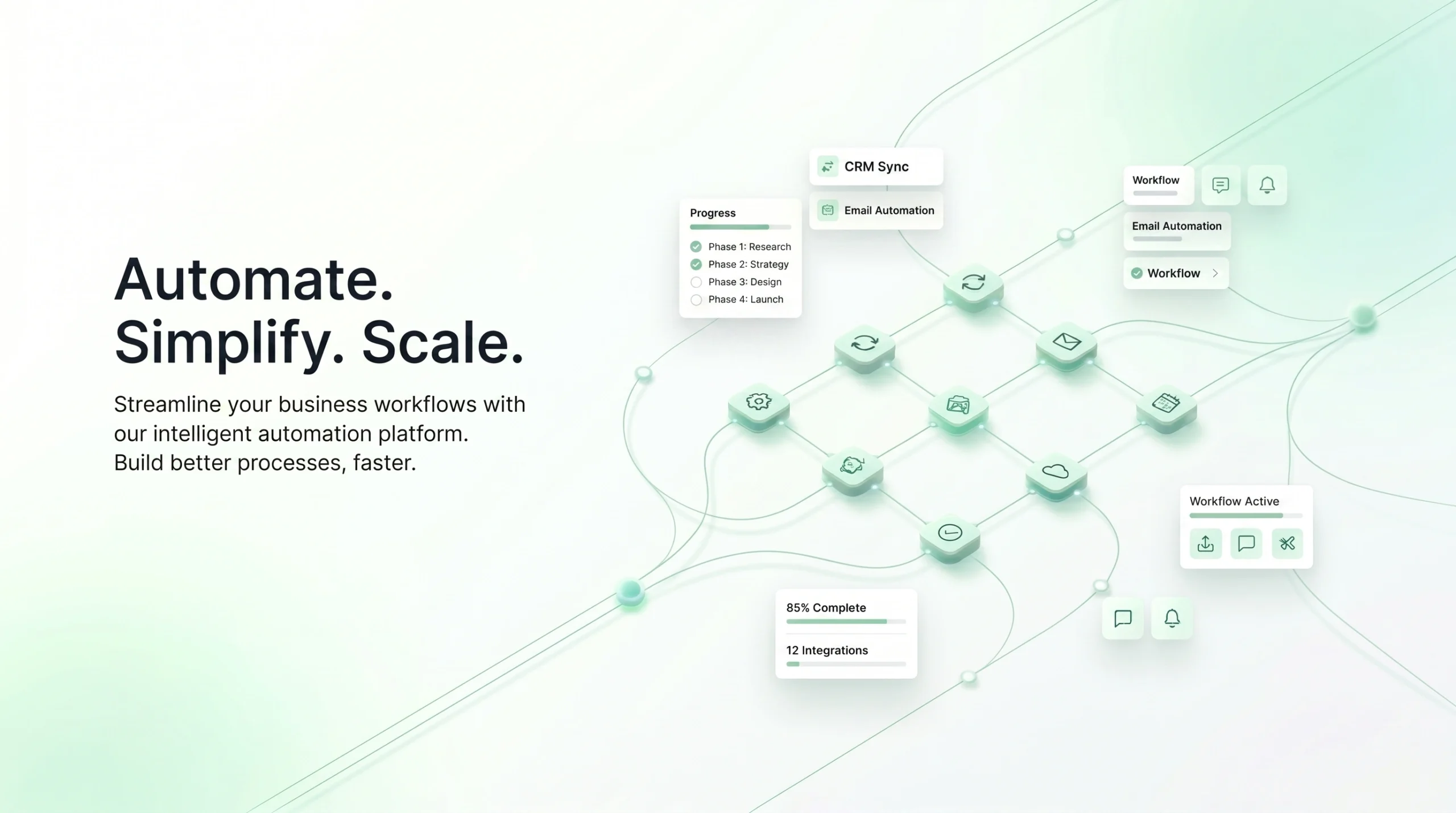
The businesses pulling ahead aren’t the ones with the most automations. They’re the ones with the most connected automations. The organizations that win will be those that link people, systems, and AI into seamless agentic workflows, because siloed agents won’t deliver real value.
Think about what that looks like in practice. A lead comes in through a web form. An AI agent qualifies them, routes them to the right sales rep, triggers a personalized follow-up sequence, and books a call, all without human intervention.
The rep shows up to the call with full context, a pre-built proposal template populated with the lead’s details, and a CRM record that’s already up to date. After the call, the outcome triggers the next automated sequence: onboarding, invoicing, or re-engagement, depending on what happened. Every step connected to every other step.
That’s not science fiction. That’s what mature automation infrastructure looks like today, and it’s what separates a business that scales from one that grinds.
What This Means for Your Team
One of the most persistent fears around automation is the workforce question. If systems do more, what do people do?
The answer emerging from businesses that have actually implemented at scale is more nuanced than the fear suggests. Automation technology now handles 57% of US work hours, but the story isn’t mass displacement. It’s mass reallocation. More organizations are restructuring their workforce and employee skills to ensure scalable AI solutions built for the future, with prompt engineering emerging as a core skill.
The work that gets automated is the work nobody wanted to do. Data entry. Manual follow-up. Report compilation. Scheduling. The work that remains, and expands, is judgment, relationship, creativity, and strategy. The businesses that frame this transition correctly aren’t asking “how do we replace people with automation?” They’re asking “how do we free our people to do the work that actually requires them?”
90% of small businesses are considering automation specifically to stay competitive as scaling demands grow. Not to shrink their teams, to stop their teams from drowning in administrative work that prevents them from doing anything meaningful.
The Cost of Standing Still
For business owners in 2026, failing to adopt automation is not merely missing out on a benefit, it is setting a course for competitive disadvantage. Competitors are not standing still. As other businesses implement AI to reduce operational costs and increase speed to market, those who haven’t will find themselves at a distinct disadvantage. If a competitor can process orders 50% faster, offer lower prices due to reduced overhead, and provide more personalized customer service, market share will inevitably shift.
This is the part of the conversation that tends to make people uncomfortable, because it doesn’t leave room for “we’ll get to it eventually.” Eventually has a cost. Every month of manual processes is a month of slower response times, higher operational overhead, more human error, and less competitive positioning, while the businesses that moved earlier compound their advantage.
Historically, small firms have adopted new technologies more slowly than larger counterparts, facing barriers including capital constraints, limited technical expertise, and integration costs. Those barriers were real when automation required custom engineering and six-figure implementation budgets. They’re substantially lower now. The tools have matured. The implementation playbooks exist. The expertise to build and run these systems is accessible in a way it wasn’t three years ago.
The barrier today is mostly decision velocity, the willingness to move from “we should look into this” to “we’re building this.
Where Automation Goes From Here
The trajectory points toward one thing: systems that don’t just automate tasks but run entire business functions end-to-end, with humans in the loop for decisions that genuinely require human judgment and out of the loop for everything that doesn’t.
By 2026, the rise of agentic automation marks the true democratization of AI, where every company can wield intelligence at scale. The businesses that build the right foundation now, connected workflows, clean data, systems that talk to each other, will be positioned to adopt each successive wave of capability without starting from scratch.
The ones that don’t will face the same reckoning, just later, and from a greater distance behind.
Automation has always promised to give businesses back their time, their accuracy, and their ability to scale without burning people out. What’s different now is that the promise has become performance. The case studies exist. The ROI data exists. The implementation pathways exist.
The only thing left is the decision.